ERBIL, Kurdistan Region - Iraqi Foreign Minister Fuad Hussein said Sunday the United States and Iran are not holding direct talks, but "indirect communication" is taking place, noting that messages are being passed through intermediaries rather than through formal dialogue.
Speaking to Rudaw's Sangar Abdulrahman in an interview in Erbil, Hussein said that "there is a lot of indirect communication" between the US and Iran but "the sound of war does not allow the voice of dialogue to prevail."
Regarding rising regional tensions and attacks by pro-Iran armed groups on Iraq and neighboring countries, Hussein said Baghdad has struggled to curb the assaults within the country, citing the groups’ military and political influence.
“It means this cannot continue this way. That is, the government must take action,” Hussein said, referring to attacks by Iraqi pro-Iran groups on the Kurdistan Region, the US Embassy in Baghdad, and sites including the Rasheed Hotel and the Iraqi National Intelligence Service (INIS) headquarters in the capital.
Since the onset of the war on February 28, pro-Iran armed groups - operating primarily under the “Islamic Resistance in Iraq” umbrella - have launched a multi-front campaign targeting what they claim are US positions in the Kurdistan Region and Iraq.
Responding to why the Iraqi government has not prevented pro-Iran armed groups from being involved in the war, Hussein said the issue has persisted for years, noting that “they also have power; they have military power, organizational power, and parliamentary power.”
On Saturday, a drone attack targeted the INIS headquarters in Baghdad, killing an intelligence officer. The attack was widely condemned, including by Iraq’s ruling Coordination Framework and Prime Minister Mohammed Shia’ al-Sudani, whose office said he called on authorities to investigate and “reveal its findings and to announce to our great Iraqi people the party responsible for this disgraceful terrorist act without hesitation in exposing those responsible.”
Hussein said the attack on INIS “was internal and the evidence is that the Prime Minister today or yesterday gave an interview saying this cannot be done [tolerated], and those who declare war and stop war must be the state, not other people. So the indications point toward them.”
Sudani said during a visit to the INIS headquarters on Sunday that “Whoever dares to shed Iraqi blood does not represent Iraq.”
Iran is believed to maintain influence over several armed groups in Iraq, many of which operate under the Popular Mobilization Forces (PMF) and have political representation within the government and parliament.
The US has carried out an intensive campaign of airstrikes against PMF factions and the powerful pro-Iran Kata’ib Hezbollah since the war began, killing dozens across several Iraqi provinces.
“Fundamentally, the US is not hitting Iraq… if this problem didn’t exist, this internal problem, the problem of weapons outside [the control] of the state,” Hussein said, adding that weapons outside state control “is not only a state itself but was also a threat to the Americans, the military American presence, and the diplomatic American [presence],” adding that US strikes in Iraq “were a reaction.”
Hussein said that months before the war, he met with Iranian Foreign Minister Abbas Araghchi, Iranian President Masoud Pezeshkian, and Ali Larijani, Iran’s national security chief who was recently killed in Israeli airstrikes. “I understood that Iran was preparing for war,” he said, adding that Larijani told him that if Iran were attacked, they would be “‘forced to make it a widescale war,’” including striking “‘anywhere Americans [militarily] are’”.
“I joked, [saying], keep us away from that issue, do not mention us [get us involved],” Hussein said he told Larijani, referring to the Kurdistan Region.
US President Donald Trump said Monday that Washington and Tehran have engaged in “productive conversations” to resolve the conflict, adding he had instructed the Department of War to “postpone any and all military strikes against Iranian power plants and energy infrastructure for a five day period.”
“My prediction is that this war will expand for a period, and after that, there will be a ceasefire or it will stop by itself. For example, the US announces that it has succeeded… but it will expand for a period,” Hussein said.
Regarding Iraq’s efforts toward a ceasefire, Hussein said, “I don't like to talk about it, but our duty is to not let war come into Iraq. To not let war come into Iraq,” adding that “of course we must remain in contact.”
He said he remains in contact with Araghchi through “message exchange.”
Following is the full transcript of Rudaw’s interview with Iraqi Foreign Minister Fuad Hussein.
Rudaw: Do you remember when we spoke last time? I asked you where the situation was heading, and you said it was heading toward war.
Iraqi Foreign Minister Fuad Hussein: Indeed I remember.
Currently, you are maintaining international contacts with regional officials and foreign ministers. Tell me please, will the war expand further, or is it moving toward a ceasefire?
Every war eventually ends. The question is when and how. My prediction is that this war will expand for a period of time, and after that, there will be a ceasefire or it will stop on its own. For example, the United States might declare that it has won - something like that - but the war will last for a while.
So, it won't end anytime soon?
I don’t know for sure, but as per what I am reading, the US and Israel are threatening to strike Iran’s infrastructure and by infrastructure, I don’t just mean military infrastructure, because they have been hitting military targets for over 20 days now. I mean economic infrastructure or infrastructure related to people's daily lives. For example, electricity, oil, gas, fuel, and water infrastructure. If they hit that infrastructure, to be honest, the situation will become very complicated and difficult for the Iranian people.
Will they actually do such a thing?
The threats are there, and that is the direction things are moving, at least. It is true that President Trump is sensitive regarding the issue of oil and gas, because that impacts the global economy and the internal situation in the US. The more expensive fuel becomes, the more the American citizen calculates their own pocket and the rising cost of gasoline, which will affect the upcoming elections - what they call the Midterm Elections. He [Trump] has those calculations in mind.
However, the continuation of the conflict in the Gulf and the Strait of Hormuz also makes energy, oil, and gas more expensive. Then, gradually within the US - whether in Congress, public opinion, or in newspapers and television - the conversation arises about how this war will go, for how long, and for what purpose? To resolve that issue, they might think or plan to deal a massive blow to Iran.
Honestly, there are no other places left [to hit]. All military infrastructure has been struck, yet Iran continues to attack and deliver its own blows. The other day, it launched a missile at [Diego] Garcia base [in the Pacific Ocean], where the Americans are stationed, which is nearly 4,000 kilometers away. This means they have long-range missiles. Iran is continuing its defense. They may have been weakened, but they are persisting. In my estimation, they did not expect this when they started the war.
You mean the US and Israel?
Indeed, I do.
They didn't expect that [level of] Iranian military capability?
In my estimation, they did not expect it, because the first blow was dealt to the leadership. I mean, at 9:30 am Tehran time, the first attack was carried out against the leadership - that is, the [late] supreme leader [Ayatollah Ali Khamenei, 1939 -2026] and everyone close to him. They predicted that if they struck the leadership, changes would occur within Tehran and other people would seize power. The Americans’ push to implement the Venezuela model was clear. They thought they would go and remove a president then change follows and people come to power who will work with the United States. They had that expectation.
Was that reading expectation out of place?
In that regard, their calculation was wrong.
Are the US and Israel stuck, do you think they are caught in a war they cannot get out of?
No, I don't see it that way. I believe Israel had different goals than the US. The US wanted to remove the leaders and bring in other leaders, not [necessarily] regime change. I mean, that was the US's goal and they spoke about it themselves, but Israel wanted to change everything and wage a war that would create chaos in Iran. There was a difference in the strategies of both sides.
The US and Israel were on different pages?
Yes, the difference was clear.
Are there currently any efforts by regional countries to end the war?
There are attempts, but the current state of the war doesn't allow for it. I mean, there are attempts and talks, to be honest with you.
Who [is exerting such efforts]?
There are talks coming from all sides, whether with the Iranian Foreign Minister [Abbas Araghchi] or with others. There is a lot of sending and receiving of messages, but the sound of war does not allow the voice of dialogue to prevail.
Are the United States and Iran in talks or not?
Not [direct talks] between them, but there is a lot of indirect communication.
Is there indirect dialogue?
It isn’t dialogue; I wouldn’t call it dialogue. Rather, an opinion is expressed and it reaches someone - a minister, for example - who then conveys that opinion to the other side. So, there is no direct dialogue. It is not dialogue.
As the foreign minister of Iraq, are you making any efforts toward a ceasefire?
I would rather not talk about that. What I can say is that our duty is to prevent the war from spilling over into Iraq and to ensure the war does not enter Iraq, we must, of course, remain in communication.
Dr. Hussein, I will come to the point of whether there is war in Iraq or not, but regarding the spillover of the conflict; Turkish Foreign Minister Hakan Fidan said after visiting several Gulf countries recently that it is possible the Gulf Arab states might also respond to Iranian attacks. Doesn’t that mean the war will become even wider and longer?
The Gulf countries have not responded up to this moment; that is the reality. However, they are also very weary about the war reaching their own doorstep - meaning the continuation of the war and them becoming a part of it. It is true they are being attacked and are indirectly part of the war, but if they were to enter the war [fully], it would mean a war in the Gulf region between the Gulf Arab states and Iran. This is a very difficult [prospect]. Do you know why it is difficult? First, they feel that if this war becomes part of the daily reality of that region, it means the state of everything - be it economic or political - will be ruined. Second, let us not forget that Israel started the war along with the US. It is difficult for Arab countries to wage a war against a country that Israel is also attacking. In the eyes of the public, it would then appear as if they are side-by-side with Israel. This position has held the Gulf countries back, even though the attacks on the Gulf countries by Iran are continuing.
In your opinion, how long will the Gulf countries remain silent?
I don’t know. My prediction is that they hope... based on my talks with them and my relations with almost all the ministers, their hope is that the war stops.
Have you spoken with Iranian Foreign Minister Abbas Araghchi recently?
Not verbally, no.
Via messages or phone texts?
We have exchanged messages.
What is Iran's latest view on the war?
I won't discuss that, but we have an exchange of messages.
Is there an exchange of views among you?
Yes, I also ask about his well being as a friend; I ask about him, his family, and his relatives.
Why has the Iraqi government been unable until now to prevent these armed groups - operating under the name of the Islamic Resistance of Iraq entity - from participating in the war?
Well, this discussion has been going on for a long time; it is not a new issue. Today we were discussing the issue of state and non-state [actors]. I have been talking about this for five and a half years. Previously, a year or two ago, when they attacked the US embassy in Baghdad, I went on television and spoke about it. This issue has existed, but they also have power; they have military power, organizational power, and parliamentary power. This is clear.
A few days ago, I had a conversation with the head of the Kurdistan Islamic Union (KIU) bloc. Dr. Muthanna Amin. He said that there are two Iraqs: an official Iraq represented by the government and its institutions, and another Iraq, which is the Iraq of these groups. I asked him which is stronger? He said that these groups are stronger than the government in Iraq.
I cannot agree with that.
My question is, why has Iraq been unable to control them until now?
Part of it is related to the Iraqi system and the Iraqi political structure. Part of it is related to the entanglement between these groups and other military and political forces. This is what led to it. But now - because their attacks continued against Kurdistan and later they began attacking Baghdad, first the US embassy, then the al-Rasheed Hotel where six diplomatic missions are based, and after that the Iraqi National Intelligence Service - it means this cannot continue this way. The government must take action. Prime Minister [Mohammed Shia’ al-Sudani] also spoke recently about the need to adopt measures because, to tell you the truth, things have gone too far; it went from attacking Kurdistan to attacking the Iraqi Intelligence Service.
Were they the ones behind the attack on the Iraqi Intelligence Service?
The attack was internal, and the evidence proving this is that the prime minister made a statement today or yesterday saying that this is unacceptable and that the one who decides on war or stopping a war must be the state, not others. Therefore, the indications point toward them.
Currently, Iraq might be the only country that the US is striking, Iran is striking, and it has internal strikes as well. Why has Iraq reached this situation?
The US does not strike Iraq [as a state]. Iran is a different story but the US would not have struck if it weren't for this internal problem [I mentioned] - the issue stems from the weapons that exist outside of state control. Weapons outside the state were not only a threat to the state itself, but also a threat to the Americans - meaning the military and the diplomatic American presence. An embassy is a diplomatic site, yet it is being hit. My prediction is that the American reaction was because of that. If the Americans hadn't been hit, they wouldn't have struck back.
As for Iran, the issue is different. Regarding Iran, even before the war - I was in Tehran about a month and a half or two months before this war began and saw Mr. [Ali] Larijani, may God have mercy on his soul. I sat with him for an hour and a half. Besides him, I saw the Iranian Foreign Minister Abbas Araghchi and the President [Masoud Pezeshkian]. But when I sat alone with Larijani and the Foreign Minister, I understood that Iran was preparing itself for war. That is, according to the Iranian calculations, war was inevitable.
Based on the experience of the 12-day war last June, that they talk about - they had a scheduled date for talks in Oman, in Muscat, on Sunday, but they [US and Israel] struck them between Thursday and Friday. So, they had thought about it. Larijani told me that the Israelis had told the Russians, "We will not try to attack unless we are attacked," and he said, "We ourselves won't attack, but they are making their own preparations to attack us. If an attack occurs, we will be forced into a widescale war,” [Larijani added]. I asked him, "What does a widescale war mean?" He answered, "Widescale war means anywhere in the region where Americans are based, because we cannot reach the United States' [mainland]." Of course, he was talking about the US armed forces and said, "We will hit them there." I even said jokingly, "Keep us out of this issue."
Did you mean the Kurdistan Region?
Yes, yes, because at that time the [US-led coalition] forces were no longer at Ain al-Assad air base, [they relocated to the Region]. Larijani laughed then, but they had this strategy that if they were hit, they would expand the war. Alongside that strategy, they have now added something else: attacking American military bases in the region and attacking oil. They have brought oil into the war; now the primary strike and the primary battle is the oil war.
Is that to apply pressure to end the war?
Yes, because anyone who reads global politics and global economics knows that oil is the foundation of economic movement in the world. Everyone knows that 20 percent of the world's market oil comes from the Gulf region. About 20 million barrels pass through the Strait of Hormuz. When that stops, oil becomes expensive, and gas becomes expensive. When gas and oil are expensive, the global economy faces a crisis - as it is facing one now.
Whether it is the European economy or the internal situation in the US, it has an impact. The US itself produces 13 million-plus barrels a day; it is a massive oil state. It essentially doesn't need [imported] oil, though it imports a little because it is a free market, but when oil prices rise, the price of gasoline in the US also goes up. When gasoline prices rise, it affects the people's attitude toward their government. In open and democratic states, when you affect the people, you affect the government as well.
To return to the groups aligned with the Islamic Resistance in Iraq entity - do you think they have effectively turned Iraq into the battlefield in this war?
Not the battlefield, but they have gradually dragged us toward war. It is regrettable. We have discussed this with the Prime Minister previously and we are discussing it now: we must not throw ourselves into the fire, a very large fire for that matter. It is true that even if you are near the fire, you might get burned, but it is different when you throw yourself in it.
Which is it now - is Iraq near the fire or in the fire?
It is near the fire.
Currently, the US is carrying out strikes against the Popular Mobilization Forces, otherwise known as the Hashd al-Shaabi, and groups aligned with the PMF are striking the American consulate and embassy in Erbil and Baghdad, respectively. How is Iraq not in the fire?
I say we are near the fire because, in reality, Iran is in the fire. Look at what has happened to the fire in Iran. We are still in the atmosphere of war, not the war itself, but if it continues like this, we will certainly fall into the fire. Therefore, it is important for the political parties - specifically the Shiite political forces, the Shiite Coordination Framework - to make a decision, because the government cannot do this [alone]. They must make a decision and direct these groups to stop their attacks.
The government cannot control these groups?
I don't believe so.
Why not?
Because it doesn't have the tools to do so. Controlling such groups is not just about military means; it is political, intellectual and ideological. That is why I say the Shiite political forces, the Coordination Framework, must play this role instead of the government. The government is different. If it becomes a matter of control leading to conflict, I don't know who holds the balance of military power - I mean, I cannot determine who has it, the government or them.
I don't know what they have or what weapons they possess, but I know they are ideological. It is different to fight an ideological group than a commissioned military group. To prevent that from happening - meaning a civil war - the solution is for the Shiite leaders to publicly announce and say that this must not be done. That is the solution.
Is Iraq heading toward a civil war if this continues?
If they strike one another, then what else is it?
If the Coordination Framework does not control them now, will it lead to civil war?
If they are not controlled, there is a fear, I'm not saying it is heading toward civil war, but there is a danger it could move in that direction because I don't know the capability of the side opposing these groups. Who is the opposing side? If it is the government, it is the Iraqi army. I don't believe the Iraqi army is prepared to fight a civil war.
Unprepared or incapable?
I cannot evaluate that; I am not a military person. Even if I knew a little about it, I wouldn't discuss it.
But another thing - and I ask you this because you were finance minister for years, as well as foreign minister and head of the ministerial council for economy: a lot of money is allocated to the Iraqi army and the military system annually in the budget. Has Iraq gained a strong army?
No. Do you know why? The Iraqi army collapsed several times. The last time it collapsed was 2014. Every weapon it had, the Islamic State [ISIS] took. Every warehouse the army had in [Nineveh’s capital city] Mosul, Salahaddin province, and on the outskirts of Kirkuk - ISIS took. Nothing remained; the army collapsed. At that time, the PMF was created by the decree of Iraq’s Supreme Religious leadership [Grand Ayatollah Ali al-Sistani]. The PMF obtained weapons initially, but later it armed itself. Alongside the PMF, some armed groups were formed. A specific portion of these groups are within the PMF, but generally, the PMF is different from these [other] armed groups. They are distinct. The PMF is a legal institution; it has a state leadership, it participates in [government] meetings and it has a budget, as you mentioned. The others are not government [entities] - you don't know their numbers, you don't know their weaponry, and you don't know where they are based.
It is often said they are the PMF and just perform these acts under other names?
Not all of them, and not a large percentage. Believe me, I say this so it is clear to our own people. We must distinguish between the PMF and those outside the PMF. It isn't unlikely that some of them, as I said, a specific percentage, have entered the PMF, but it is a small percentage, and the PMF as an institution is different.
Then why is the US currently striking both?
I don't know if the US is striking them or another side. You say it is the US.
Is it not the US?
I don't know; the US itself hasn't announced that they are striking them. Have they announced it? I want the official level, but those who have been hit are mostly the armed groups.
But official brigades and official headquarters of the PMF in Kirkuk, Anbar, and al-Qa'im district have been hit several times?
True, there is an overlap, and in the strikes, there is also an overlap.
You mentioned that Ali Larijani warned before the war that if it starts, it will expand?
They [the Iranian side] didn't just tell me; they told other people as well.
Yes, so Iran had conveyed this message before the war?
Yes, but they were saying, “We do not want a war, but if war erupts, we will defend ourselves."
Did the US tell you anything before striking those groups in Iraq? Did they have any message?
No. Do you know how the war [escalation] essentially happened? There were the Geneva negotiations, and they had progressed a lot - really progressed. The Omani Foreign Minister [Badr Albusaidi] went from Geneva to Washington - the same person who was mediating. He called me from Washington. He had seen the Vice President of the United States and had brought them a clear message from Iran: "We are ready to reach an understanding." An understanding on the nuclear dossier and on the issue of uranium enrichment. I think they have 460 kilos, 450 kilos or something like that, and they were willing to resolve that too.
Iran expressed readiness to resolve it?
The Iranians told me themselves, "We want to close this file, but we will not discuss the [ballistic] missile issue." They said they would not negotiate on the ballistic missile program - that it is an internal and defensive matter - but on the issue of the nuclear project, "We are ready."
In Geneva, they moved forward significantly. The Omani Foreign Minister [Albusaidi] later wrote an article, but before that, he called me from Washington and said, "I took that Iranian proposal to the Vice President, and even he said, 'By God, they have come forward a lot.'" I asked him: "How do you see the situation?" He said, "My prediction is that there will be war; the atmosphere is an atmosphere of war. I came to solve the problem, but the atmosphere is one of war. I don't know if they will strike today." This was on Saturday, at 1:30 am local time - obviously it was evening there. At nine-something, Tehran was struck. This means that the Iranian proposal on the nuclear project and how far they had come forward was not accepted because the logic of war had prevailed.
Did Israel cause the war for the US or did the US intend to go to war itself?
I am not in the business of analysis. If I were to analyze, I would discuss everything. The war happened, and those who participated were Israel and the US.
I ask you this because I know you don't just analyze - did the US intend to go to war itself, or did Israel make it happen?
The US and Israel had daily contact on this issue, whether on the matter of war or... but no other state was aware. There was analysis, there was information, but neither NATO was aware, nor the states participating in NATO - even though the US leads that military alliance - nor the Europeans in general were aware, nor were the US's allies, nor the Gulf states. There was analysis and reading of the situation. I had my prediction since November, but the US told no one about the timing of the war and the strike. That is why you see the current position of the Europeans in which they are telling [the US], "You did something and didn't tell us, and now you say 'come help.' How?"
Trump also has many complaints about NATO and the Europeans. What happens to NATO in your opinion?
I don't know, but there is a major problem in the world now and a major problem between Europe and the US. Not just the NATO issue - there was even a problem over Greenland - I mean, there are problems. How they will solve it, I don't know.
The intent of my question was: did the US tell you anything before striking those groups inside Iraq?
It was always said that "if these [Iran-aligned armed] groups strike us, we will strike them back."
If they hadn't struck the US, the US wouldn't have struck them?
What do you mean by “struck the US?” You strike an oil company in Sarsang - the company is American, right? The owner of the company in Washington can speak and has good connections. His voice is heard. If you strike not just the US itself as an embassy, but US interests, the US considers it a strike against itself. The man goes and lobbies; he is the owner of an American company, he can reach the Trump administration and he makes his voice heard.
What has been Iraqi Prime Minister Mohammed Shia al-Sudani’s response, as Commander-in-Chief of the Iraqi Armed Forces, to those groups regarding the attacks on the Kurdistan Region and the US embassy in Baghdad?
Today it became clearer. Previously, it was among ourselves and through efforts with them and through other people, but today and yesterday it was more; he spoke clearly, especially after the attack on the Intelligence Service headquarters in the Mansour area in Baghdad where an officer was killed, today it was clear. To tell you the truth, this is the correct stance, but his stance will be stronger if the Shiite [political] leaders also take a stand. Of course, if they don't, it’s a problem.
Mohammed Shia al-Sudani has become somewhat clear, but will he turn this stance into action against those groups?
Action is difficult without political support - the political and moral support of the Shiite leaders. The Shiite leaders need to have a stance on this matter.
Are the Shiite leaders divided on this issue?
They disagree on many things, but on this issue, they haven't had a public stance so far. In bilateral meetings, they have a stance, but it isn't public. Now, it's not unlikely they will make it public. If they do, it will empower the government and make the Prime Minister's position very strong. But if they don't, then no.
You mentioned the Shiite parties - the process of forming the new Iraqi government seems to have stalled?
That is correct.
Is it related to the war or to internal disputes within the Coordination Framework?
It is related to both. The Coordination Framework did not reach a conclusion on the issue of the Prime Minister. Mr. [Nouri] al-Maliki was officially a candidate and is still a candidate, but a group of them asked him to withdraw. He isn't withdrawing and says, "With a broad meeting, just as you nominated me, let the decision be made with a broad meeting." He says, "In the meeting to nominate me, except for one or two people out of 12, the others voted for me. Now let's have a broad meeting and if it's by vote, I will withdraw; otherwise, why should I withdraw? By the same mechanism I came in, I must withdraw by that mechanism." Well, that mechanism is not being implemented.
The parties won't do it?
Not all of them; they can't. Some of them are with him; that is one of the issues. Another issue is that the war started and Iraq is in a difficult situation.
The predictions were that the process might stop during Ramadan. Do you think it will restart after Eid?
We must find a solution after Eid. That isn't the only problem; the Presidency is also a problem within the Kurds. We haven't reached a conclusion either, because without a President, there will be no Prime Minister. Right?
Correct. Before I come to the President, is Maliki still insistent on staying?
Until two or three days ago when I came back, he was still insistent on staying and says, "I won't withdraw unless a decision is made by a meeting. I came by a meeting and the decision to remove me must be by a meeting; if not, why should I withdraw."
What about the President? Do the KDP [Kurdistan Democratic Party] and PUK [Patriotic Union of Kurdistan] have any dialogue?
It has stopped; there is no dialogue.
Why?
That is another matter.
Is that also related to the war?
No, there was no dialogue even before the war.
Dialogue had stopped even before the war?
Yes.
Now that this war has happened and there is a lot of talk about unifying the Kurdish home, has no new position emerged for dialogue between the KDP and PUK?
To unify the Kurdish home, there must be a meeting.
There is no meeting?
No.
No contact either?
I don't know if there is phone contact or not, but there are no meetings.
Is it just not about that [the presidency] or not at all?
Not at all.
On nothing? Even on this [war] situation, there is no contact between the KDP and PUK?
I don't believe so. It's not unlikely that each side has its own perspective.
Are the perspectives of the KDP and PUK different now regarding this situation?
No, naturally, regarding the war, everyone hopes to stop it, but it's not unlikely their reading of the situation is different. It is hard to read now, because if a reading isn't based on information, it becomes analysis. Most readings are based on the media, because who is the decision-maker in this war? The decision-maker is Iran, Trump, Netanyahu. Who can read this?
Iran, Trump, and Netanyahu—or Iran, America, and Israel?
I say "Trump." Trump is the decision-maker. In Israel, Netanyahu is the decision-maker. Who makes decisions in Iran? I don't know now. I used to know, but now I don't.
Who makes decisions in Iran now?
I don't know.
Who is left now in Iran?
Well, people are left. The second and third-tier leadership have all been eliminated, but of those who have come forward, who is the decision-maker and how? Is it a group or one person? My prediction is that it is a group.
Iran says the health of the new Leader is good and he has no issues. America sometimes says he was killed, other times it says he is severely wounded. During this time that you spoke with the Iranian Foreign Minister, did he say anything about the Leader's health?
We haven't discussed that topic. I don't ask and he doesn't mention it. It isn't discussed.
How much oil is Iraq selling now?
It isn't selling, except for what goes through Kurdistan. The Kurdistan [share] was supposed to be 250,000 barrels from Kirkuk. If the Kurdistan oil fields also resume work - I don't know if they have started or not - the Kurdistan Region can also add 100-150-200 thousand barrels. That means it’s not unlikely to reach 400,000 barrels if the fields in the Kurdistan Region also restart, and I don't know if they have restarted or not. It is only that and nothing else.
Before the war, Iraq had a daily production of 4.3, 4.4-4.5 million barrels. About 1 million and 100 thousand was for refineries and internal consumption. 3 million and 200-300 thousand was for export. Now, 3 million 200 thousand is not being sent; that isn't just today, that amount hasn't been exported for more than 10 days because initially, it was being produced. There was production, but not export. Production continued until the storage tanks were full. Well, when they were full, there was no more space. If you produce oil now, what would you do with it?
So oil production has stopped now?
Yes, in most fields.
Production in Iraq has stopped?
Yes, because if you don't export it and you have no place to store it, why produce it? And if you don't produce, it will have a negative impact on the oil wells in the future. This also affects relations with those [international] companies because you have contracts with them. That is why I think the Oil Ministry announced a few days ago that they cannot [continue] because of Force Majeure (extraordinary circumstances). It is the state of war. To be honest, what is happening in Hormuz isn't a closure [blockade], but because it is a war and people are afraid - those on the ships are afraid to come. Those who could come or aren't afraid see that the insurance for ships is gone. Those companies - specifically there were six companies - that provided insurance for these ships for that region say, "we cannot bear the risk." Well, you have to pay money. You pay money and the ship doesn't even go? And if they strike it, the insurance has to pay. So it’s a series of issues.
Why can't Iraq send oil through Iran?
Iraq doesn't have its own ships to talk to Iran and say "this is my ship, let it pass." You have to rent a Greek ship or one from another country. That ship won't come because it has no insurance. And those on the ship, their lives are at risk. Iraq doesn't have the tankers itself. it has small things but doesn't have what it needs to send oil. So, export has stopped. Production has also stopped now.
How many days has production been stopped?
I don't know. A few days. But exporting stopped a while ago.
Does Iraq get its monthly oil money back?
No, when you sell today, the money comes after two or three months. We sold in January and February, which means the money for that will come in March, April, and maybe the start of May. It's the old money, at the old price which was 60-62-63 dollars per barrel. Now, this month, it hasn't sold anything. If it continues like this - meaning if it sells nothing for March - then for May or June, no oil money will come because you sold nothing. It's different now; from that Kurdistan pipeline, 250,000 barrels, this money comes.
If Kurdistan adds its own to it and it becomes 400,000 barrels, the price of oil also goes from 63 dollars to 108 dollars. Oil prices are different. What goes to Asia, China, India is 160-170-180-190 dollars. The markets of China, India, and Japan need it. But for Europe, it is 110-115 dollars. Now if Iraq sells 400,000 barrels at a price of 110 dollars, the money is different from when it sold before at 60 or 61 or 62 dollars. Another solution is for Iraq to start selling oil by tankers toward Jordan and Syria, but the price will be different, there will be more expenses, and there are security and theft issues involved.
But can it sell a small amount that way?
Yes, it can sell a portion that way. Meaning some money will come back to it, but not like before.
Can it easily bring the money back?
Money for what?
Money for January and February?
Money is coming, yes. You mean the dollars?
Yes.
Yes, it’s your own dollars. The transfer is different, but a solution can be found. There are dollars in the market and in the Central Bank.
Given that it sold oil for January and February, are salaries for March and April guaranteed in Iraq?
If we talk about the money, the money is guaranteed, but how the salaries will be - I don't know where the situation in Iraq is heading and how they will handle it. Now you have to spend money in places you didn't account for, like the security situation, food - because you have to ensure the society is stable - and military movements. This all [needs] extra money.
Is that at the expense of salaries?
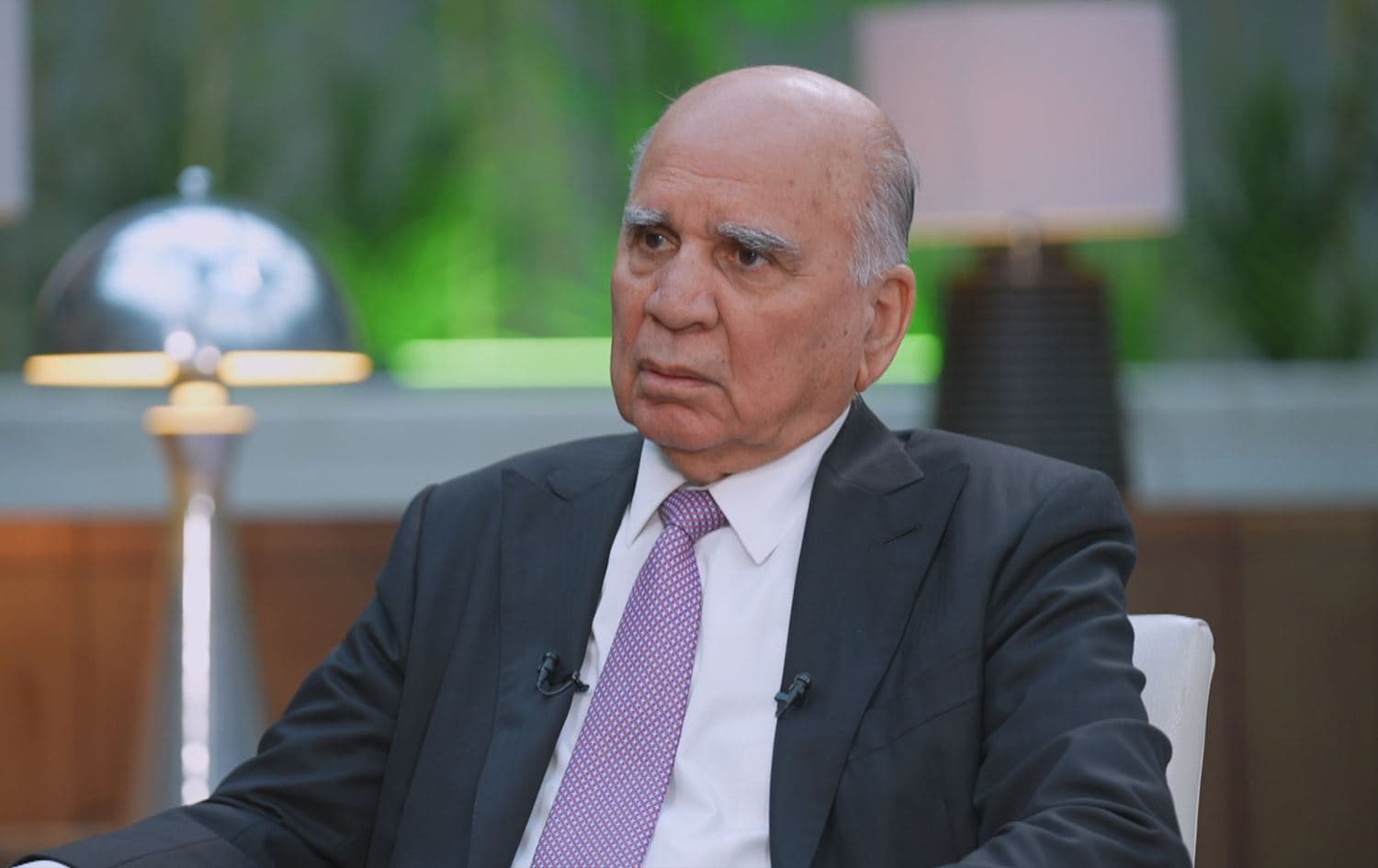
Iraqi Foreign Minister Fuad Hussein, in an interview with Rudaw in Erbil on March 22, 2026. Photo: Screengrab / Rudaw
Interview23/03/2026
'Indirect communication' underway between US, Iran: Iraqi FM
2:35
Related Articles
It's not unlikely that these things aren't in the budget. After all, this is an emergency situation. But generally, if the war stops soon, there won't be a major problem. But if the war continues, it’s certainly a problem.
Are March salaries in Iraq guaranteed now; will they start after Eid?
I don't know.
I mean [for the rest of] Iraq?
Yes, they must be paid.
Does it have the money to pay March salaries?
The money will be paid; salaries will be paid. Iraq’s reserves are not bad. I’m not saying we should take from the reserves, because that creates a type of inflation and weakens the value of the Dinar against the Dollar. But anyway, what I’ve understood from the colleagues responsible for these things is that we can manage for five to six months.
Iraq can pay salaries for up to five or six months?
Well, how it pays them I don't know, but it can.
"How it pays them" - what do you mean? Will there be cuts or half-salaries in Iraq?
I don't know.
Has this been discussed?
I don't like to talk about it because this is all prediction. If the war stops, the problems will be solved and we will export oil. So why talk about something that hasn't happened and is only a prediction? I shouldn't talk about it, and if I do, it will have an impact.
Has the Iraqi government followed up on the possibilities?
The Iraqi government has studied it.
Is it true Iraq is thinking about printing money?
Why would it print? There is no liquidity. I think there are 104 trillion printed Dinars. The liquidity problem in Iraq is that people keep money at home; they don't put it in the bank. Part of it is culture, and part of it is related to the security situation. If your security situation is bad, you don't put money in the bank; you keep it at home so that if something happens, at least you and your family have money. Part is culture, but part is related to the banks. People don't trust banks. Sometimes you put money in the bank and go to withdraw it, and they either don't give it back or give you only a portion. Well, why should a citizen deposit money? This has created a problem and there is no liquidity. There is money, but it doesn't return to the economy. If liquidity doesn't return to the economy, it vanishes.
This problem must be solved. Before this war, we talked a lot about solving the liquidity problem and how to bring it out of the homes. There are a series of economic measures - for example, changing the currency. For example, that was done in India and after a week people brought all their currency to exchange for new currency. Some states also increase interest rates. For example, Turkey sometimes brought it to 50 percent and 60 percent, and people took their money to the bank and in six months their money doubled. Some discussed removing several zeros from the Dinar, which is also just changing the currency. Within the government, all those topics were discussed, but no result came of it and the war broke out. Let’s see what happens after the war.
Is Iraq's economic situation bad?
No. In any war near any country, there will be an impact on that country. Iraq's situation has become such that it cannot export oil, and that is the major problem.
And is its revenue all based on oil?
88 percent to 90 percent of Iraq's budget revenue is oil, and the rest is non-oil. Despite that, we produce about 1 million and 100 thousand barrels of oil for the refineries, and they sell it - meaning they turn it into gasoline and fuel and it is sold. Our problem is the black oil that comes out of the refineries; what to do with it? Because throwing it away is not good, and a way must be found to export it. The 250,000 barrels sent through the Kurdistan pipeline started, and if Kurdistan adds its own to it, that would be very good. Therefore, some revenue is returning to Iraq and now the price is high, as I mentioned.
Will Erbil and Baghdad agree on the customs ASYCUDA [Automatic System for Customs Data] system?
I don't know, but the oil issue was resolved; that had created a major problem between the Kurdistan Region and Baghdad.
The [oil] that wasn't being exported and was later discussed?
Well, what was the problem? [Exports of] oil were tied to that system. Kurdistan itself is under pressure regarding that system and customs and taxes, but tying it to oil, in my opinion, was not correct. In the end, the Kurdistan government agreed that the oil should go, and through dialogue with Baghdad, they reached that conclusion - which was a good result - and both sides agreed to send the oil through the Kurdistan pipeline. Because that is Kirkuk oil, and in 2014 it again became such that a large part of the oil pipeline in Baiji and Mosul fell into the hands of ISIS. I say this for history: I remember in 2014, [Haider] al-Abadi had just become Prime Minister and he asked me to go with him to New York for the annual UN meetings. There we saw President Obama.
Abadi said in a private meeting, "I have a task for you." This was one month after he became Prime Minister. An advisor was sitting there and the Iraqi ambassador in Washington had come to New York and was sitting there. Abadi said, "I have a task for you," and I asked: What is it? He said: "The Kirkuk oil pipeline should be linked to the Kurdistan Region oil pipeline." I said, "What are you saying?" and Abadi repeated it two or three times. The advisor sitting there said, "Man, he hears you, but he likes for you to repeat it two and three times." At that time, they were linked together.
Did you find the request strange, since you asked him to repeat it?
You know, the issue of linking Kirkuk and Kurdistan Region oil has always been opposed in Baghdad. There is a concept behind that, but when Abadi said it, I found it strange. Abadi discussed it with me. That was how about 100 to 120 - and I think it reached 130 thousand - barrels of Kirkuk oil would go into this current pipeline, and along with Kurdistan's oil, they reached nearly 500,000 barrels. That was the case until 2017 when the situation deteriorated, and then it stopped. So, sending Kirkuk oil through this pipeline has a history. I'm not talking about the pipeline that fell into the hands of ISIS. Now, when oil wasn't being exported, it was right for us to accept that [the linkage].
Do you mean the Kurdistan Region?
Yes, and it was correct that it was later accepted. That was in the interest of both sides and it should have been that way; it wasn't a loss for anyone. The Americans were also on the line with us and they also requested that oil enter the market so that it would be a bit cheaper. Turkey was also on the line. Thank God it was resolved; otherwise, a major problem would have been created. But the customs issue must also be resolved and it needs a meeting. Therefore, these are separate and let us not link them together.
SuggestedQuestions