On Sunday, while Iranian missiles were still falling near the Dimona nuclear research center in Israel, Donald Trump reached for his phone. He issued a high-stakes ultimatum via Truth Social: "If Iran does not fully and without threat open the Strait of Hormuz within 48 hours from this moment, the United States of America will strike and destroy their power plants, starting with the largest of them."
However, before the 48-hour clock expired, the U.S. President shifted his stance. In a follow-up post, Trump announced that very good and productive conversations had taken place to resolve the conflict. Consequently, he instructed the Department of War to halt all planned kinetic strikes against Iranian electrical and energy infrastructure for a five-day negotiation window.
Senior Iranian officials, however, were quick to dismiss the claim of a diplomatic breakthrough. In statements carried by regional media, Tehran denied being in direct negotiations with Washington, characterizing the President’s remarks as a "psychological operation" intended to manipulate global financial markets.
Despite the declared pause, the ground reality remains volatile. On Tuesday morning, reports emerged of targeted strikes against a gas pipeline feeding the Khorramshahr power plant, a gas administration building, and the Isfahan gas pressure control station. This raises a critical question: what kind of attack can Iran’s electricity system actually withstand, and how would a collapse of the power sector impact the daily lives of 88 million people?
A system in constant crisis
Iran’s electricity infrastructure is currently teetering on the edge of failure due to decades of internal mismanagement and underinvestment. While the Iranian Ministry of Energy lists a nominal installed capacity of over 92,000 megawatts (MW), analysts warn this figure is largely theoretical.
According to a June 2025 analysis by the Carnegie Endowment for International Peace, the actual deliverable capacity is closer to 62,000 MW. The report identifies a "widening gap" caused by:
Aging Infrastructure: The average efficiency of Iran's thermal plants is below 33%, with the Iranian Parliament Research Center noting some newer plants struggle to reach 30% efficiency - far below the global combined-cycle standard of 55-60%.
Transmission Losses: Approximately 40% of natural gas and electricity is wasted during production and transmission.
The economic toll is already staggering. Data from the Iran Chamber of Commerce Research Center estimates that existing power outages cause 18,000 trillion Rials ($12.2 million) in daily economic losses, with 51% of those losses hitting the industrial sector. In 2024, steel and cement hubs in Isfahan, Yazd, and Khuzestan saw their power supply slashed to nearly half of their 1,000 MW requirement during peak summer months.
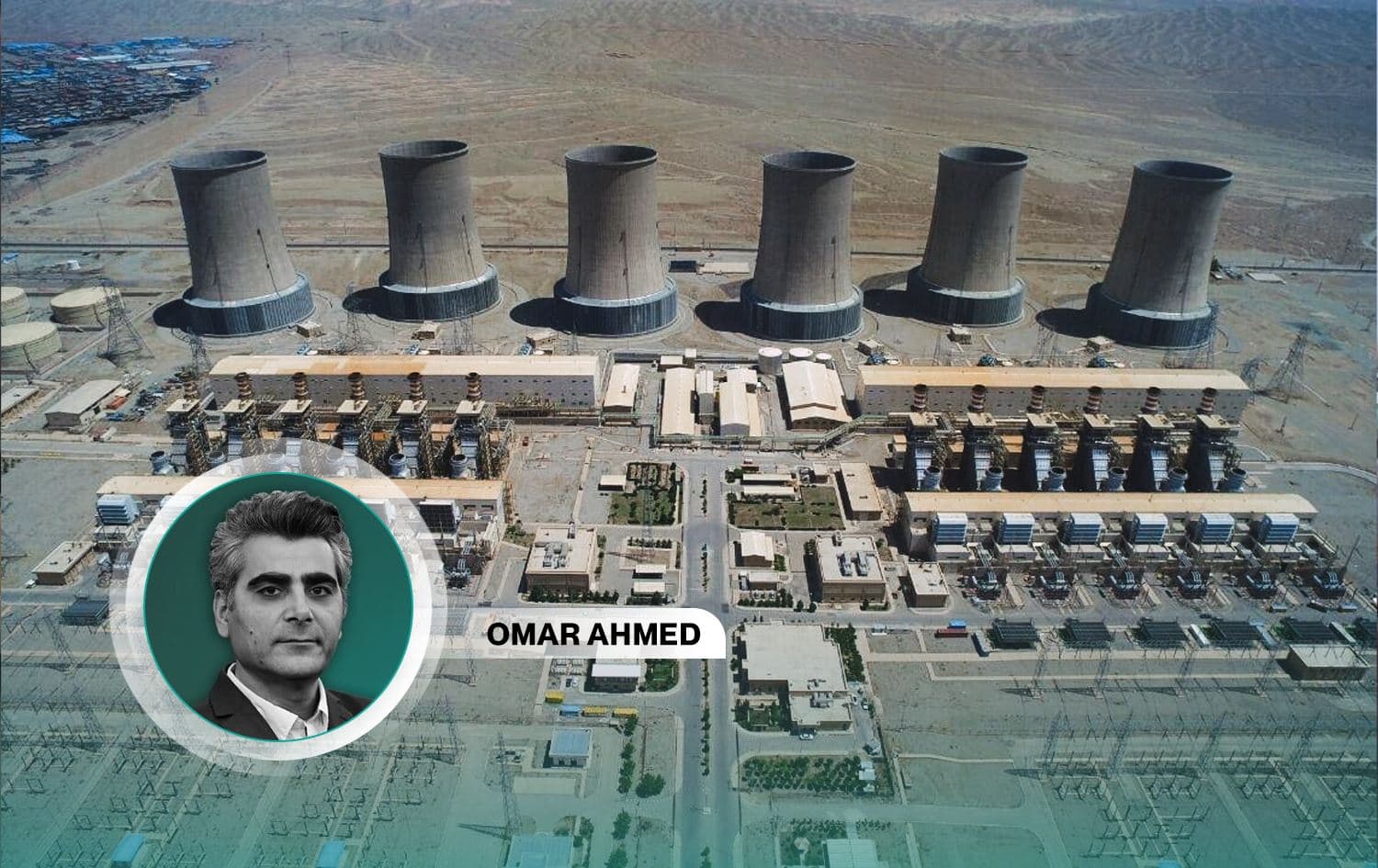
Omar Ahmed and Iran's Damavand power plant. Graphic: Rudaw
Home25/03/2026
Iran’s power grid on the brink
2:35
Related Articles
Opinions26/03/2026
Twenty-eight months, three wars, one bill
Opinions25/03/2026
Vessel arrivals in the Strait of Hormuz: who is transporting Iraq's oil?
"The government is scrambling to manage the crisis because this is like a powder keg that can explode and create unrest across the country," says Seyed Hamid Hosseini, a member of the Iran Chamber of Commerce energy committee, in a recent interview with EA WorldView.
The seasonal paradox
The timing of Trump’s ultimatum is analytically decisive. According to a seasonal analysis cited by the Princeton Journal of Public and International Affairs, air conditioning accounts for approximately 35% of Iran’s national peak load.
In the current spring demand fluctuates between 30,000 and 38,000 MW. With a deliverable capacity of 62,000 MW, the grid currently enjoys a surplus of roughly 24,000 MW. However, this buffer is temporary. In the summer of 2024, the deficit reached 14,000 MW - equivalent to twice the total electricity output of Azerbaijan.
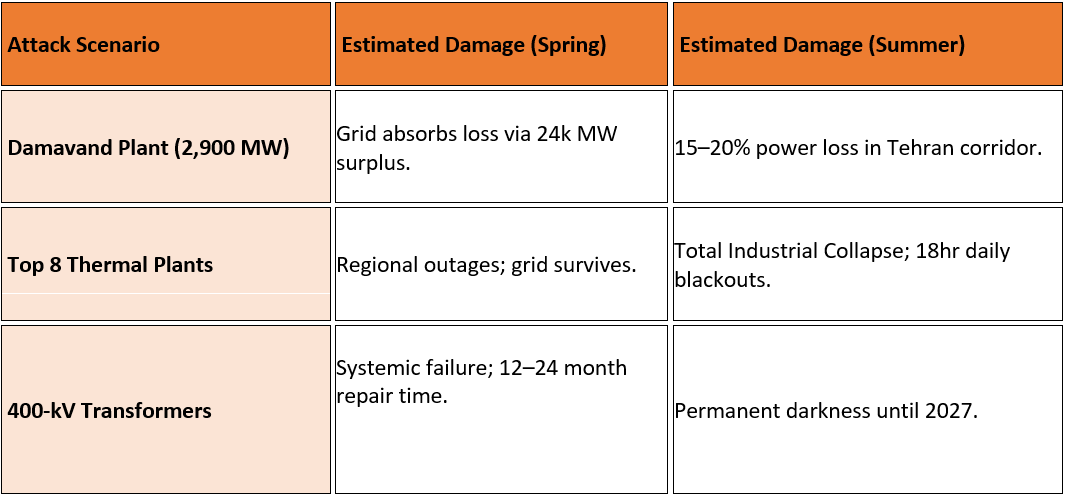
The most crippling strategic option involves Large Power Transformers (LPTs). These are custom-built and cannot be manufactured domestically. According to industry data, destroying just 10 to 15 of these critical nodes would create a blackout that no repair effort could resolve before the summers of 2026 or 2027.
The "soft bomb" threat: Graphite and blackouts
Military sources suggest the U.S. may utilize BLU-114/B "Graphite Bombs" - often called "soft bombs." These weapons release a cloud of chemically treated carbon filaments that short-circuit high-voltage lines.
First used in the 1991 Gulf War to disable 85% of Iraq’s grid; later used in 1999 to cut 70% of Serbia’s power.
In June 2025, China demonstrated an advanced 490 kg graphite warhead, signaling the weapon’s evolution into a tool for "silent sieges" that can collapse an economy without the massive civilian casualties of conventional explosives.
The regional ripple effect
Tehran’s response has been one of "calibrated escalation." The IRGC has warned that any strike on Iranian power will result in the "complete closure" of the Strait of Hormuz.
Parliament Speaker Mohammad Baqer Qalibaf stated on social media that energy and oil infrastructure across the entire Gulf region - including desalination plants - would be considered "legitimate targets" for retaliation. While European leaders have welcomed the five-day pause, the deadline is set to renew this weekend. If the grid is hit, the IRGC’s message is clear: the entire region will go dark along with Iran.
Omar Ahmed is editor-in-chief of Rudaw’s Economy Desk.
The views expressed in this article are those of the author and do not necessarily reflect the position of Rudaw.
SuggestedQuestions